
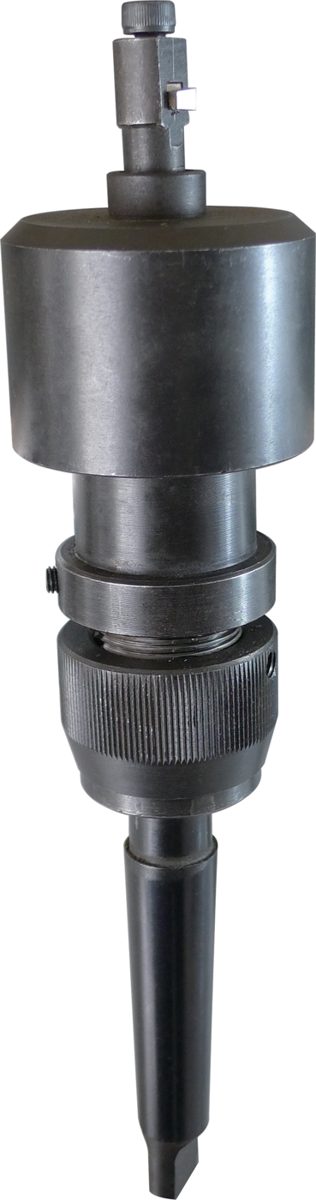
Photos may show optional equipment.
KHC Series Tube Hole Grooving Tools (KHC-A, KHC-B, KHC-C)
Cuts grooves in tubesheet holes before tube expanding to raise tube-to-tubesheet joint strength.
KHC grooving tools, also called serrating tools, cut grooves in tubesheet holes before the tubes are expanded. Grooved holes give a stronger tube-to-tubesheet joint in heat exchangers, condensers and boiler drums. Groove depth and position in the hole are adjustable. Tools cover tube holes from 0.472 in (12 mm) to 2.24 in (57 mm).
Key features
- Grooves tubesheet holes before expanding for higher joint strength
- Adjustable groove depth and position within the tube hole
- Single-blade KHC-A; double-blade KHC-B and KHC-C
- Grooving bit changes quickly for continuous operation
- Hand use for regrooving, or in milling and drilling machines
At a glance
- Tube hole range
- 0.472–2.24 in (12–57 mm)
- Standard groove pattern
- 3-6-3 mm (0.118-0.236-0.118 in)
- Max. groove depth
- 0.079 in (2 mm) KHC-A; 0.098 in (2.5 mm) KHC-B and KHC-C1
- Shank
- Hex or Morse taper No. 2, 3 or 4
- Weight
- 2.2–19.8 lb (1–9 kg)
- Country of origin
- China
Specifications
| Model | Tube hole | Groove pattern | Shank | Weight |
|---|---|---|---|---|
| KHC-A1 | 0.472–0.984 in (φ12–φ25 mm) | 3-6-3 mm | Hex | 2.2–2.6 lb (1–1.2 kg) |
| KHC-A2 | 0.472–0.984 in (φ12–φ25 mm) | 3-6-3 mm | Morse taper No. 2 | 2.6–3.3 lb (1.2–1.5 kg) |
| KHC-B1 | 0.630–0.984 in (φ16–φ25 mm) | 3-6-3 mm | Morse taper No. 3 | 4.4–6.6 lb (2–3 kg) |
| KHC-B2 | 0.984–1.260 in (φ25–φ32 mm) | 3-6-3 mm | Morse taper No. 4 | 4.4–6.6 lb (2–3 kg) |
| KHC-C1 | 0.984–1.772 in (φ25–φ45 mm) | 3-6-3 mm | Morse taper No. 4 | 8.8–11.0 lb (4–5 kg) |
| KHC-C2 | 1.772–2.24 in (φ45–φ57 mm) | 3-6-3 mm | Morse taper No. 4 | 15.4–19.8 lb (7–9 kg) |
Application
Grooving tubesheet holes before expanding is common practice on heat exchangers, condensers and boiler drums. During rolling, tube material flows into the grooves. This improves the joint strength between tube and tubesheet.
KHC tools can be used by hand to clean up existing grooves during retubing. For new (OEM) tubesheets they run in milling or drilling equipment.
Series overview
- KHC-A: single blade, hex or Morse taper No. 2 shank, tube holes 0.472–0.984 in (12–25 mm).
- KHC-B: double blade, Morse taper No. 3 or No. 4 shank, tube holes 0.630–1.260 in (16–32 mm).
- KHC-C: double blade for large tube holes, Morse taper No. 4 shank, 0.984–2.24 in (25–57 mm).
- Standard bit groove pattern is 3-6-3 mm; other bit configurations can be made to your design.
Frequently asked questions
Why groove tubesheet holes before rolling?
During expansion the tube wall is pressed into the grooves. This mechanical lock increases the strength of the tube-to-tubesheet joint compared with a plain hole.
Can the tool be used by hand?
Yes. KHC tools can be used manually to clean up existing grooves, for example during retubing. For new tubesheets they are mounted in milling or drilling equipment.
Which model fits my tube hole?
Select by tube hole diameter and machine spindle: KHC-A for 0.472–0.984 in (12–25 mm), KHC-B for 0.630–1.260 in (16–32 mm), KHC-C for 0.984–2.24 in (25–57 mm). Check the shank type against your spindle.
Can the groove pattern be changed?
The standard bit cuts a 3-6-3 mm pattern. Bits with other configurations can be supplied to match your design requirements.
Request a quote for this product
Tell us your tube size, material and quantity. We reply with the right configuration.